


The introduction of Dongjiang water reduced Hong Kong's reliance on local rainwater as its primary water source. Since then, Hong Kong has had a reliable water supply. However, the increasing impact of climate change and the occurrence of more frequent droughts and floods increases the possibility of water scarcity around the world, including in Hong Kong. Since 2008, the HKSAR Government has implemented the Total Water Management Strategy (the Strategy) and has made long-term plans to develop a diversified and stable water supply model for the city.
The Assistant Director for Development, Ir Wilson MA Hon-wing, says the WSD had been improving its waterworks and water treatment technologies over the years. But in the long run, the challenges faced by Hong Kong cannot be ignored. “On the one hand, water demand will increase as the city’s population and economy grows. However, the amount of local water gathered may decrease due to climate change. As for the Dongjiang water - which we have been relying on – the needs of cities in the Dongjiang basin are also high,” adds Ir MA.
As the main water supplier of Hong Kong, the WSD needs to have a broad and forward-looking vision in its overall water planning. Total Water Management is a modern concept of holistic water resources management. In simple terms, it means tapping into all sources of water and reducing consumption. "At present, we are adopting a two-pronged strategy to contain the growth of fresh water demand, while building resilience in the fresh water supply by diversifying water resources. By promoting water conservation, managing water loss and expanding the use of lower grade water for non-potable uses, we hope to reduce average fresh water use per capita by 10% by 2030,” says Ir MA.

The WSD has adopted the "Plan, Do, Check, Act" management model when planning and implementing its water supply policies to achieve its water saving targets, Ir MA explains, "We have to plan in advance. That is why we formulated the Strategy back in 2008. Then we implemented and enforced the measures step by step, which is the 'action' stage.”
The WSD reviewed and updated the Strategy 10 years after its implementation, evaluating the effectiveness of various measures and establishing key performance indicators. “We assessed and prioritised the water management options in terms of their resiliency, economic factors and sustainability, and adjusted the measures to meet the challenges,” says Ir MA. The review was completed in 2019. The updated Strategy (Strategy 2019) will adopt a two-pronged approach:
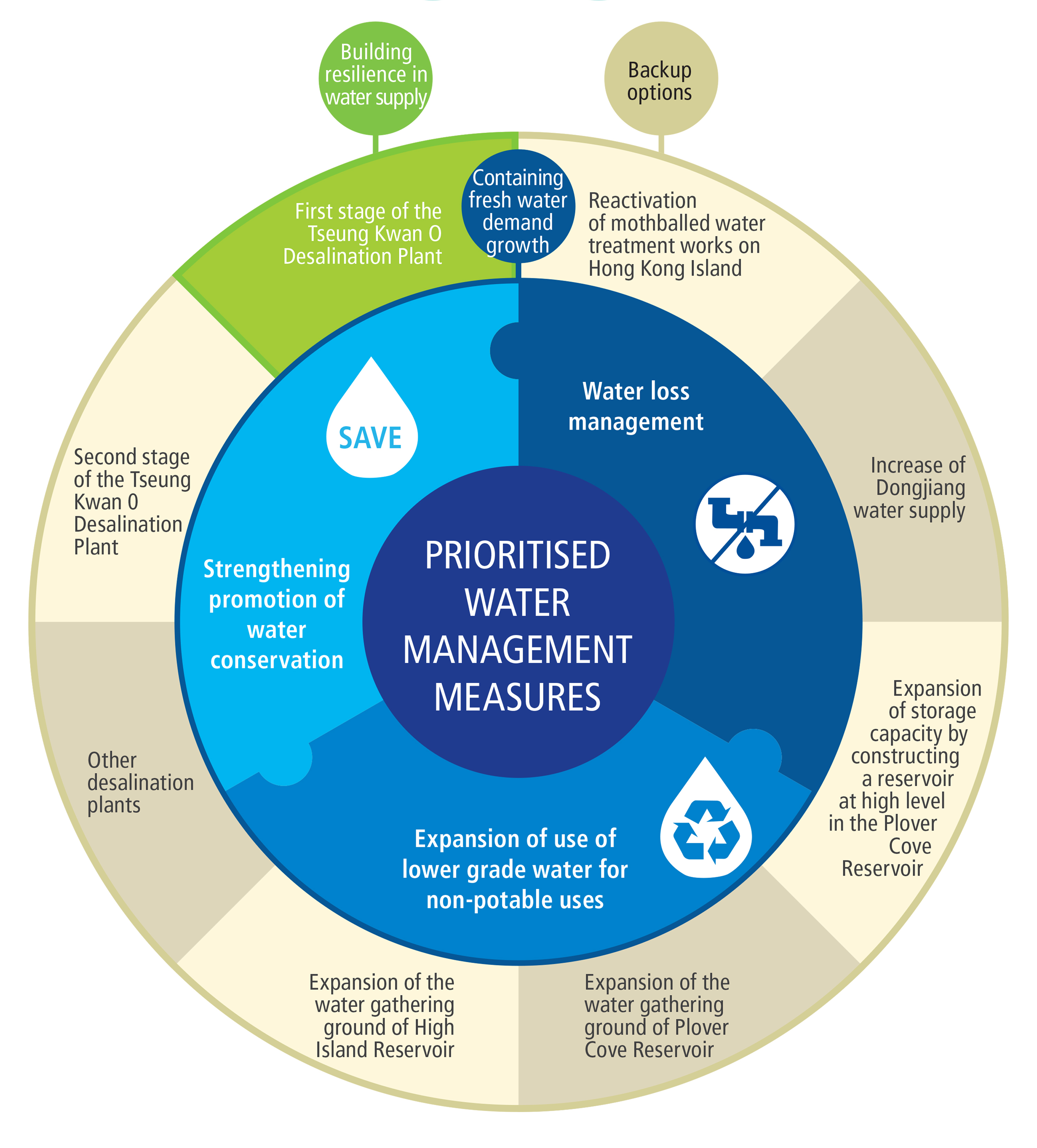
- After evaluating various water management measures, desalination was identified as the best option to enhance the resilience of the fresh water supply (see the article "Desalination as a Strategic Water Resource" in Chapter 2).
- Increase the use of lower grade water for non-potable uses and reduce fresh water consumption (see the article “New Water Resources” in this Chapter)
- Water loss management (see the article "Smart Technology Management of Water Mains and Water Leakage" in Chapter 3)
- Strengthening the promotion of water saving (see the article "Initiating Water-Saving Habits at a Young Age" in Chapter 6)
The WSD is currently working with government departments on water supply planning for a number of new major development projects, including the Northern Metropolis and Kau Yi Chau Artificial Islands. As these projects involve new land or re-planning of existing land, there will be an increase in long-term water demand. This presents bigger issues for Hong Kong’s water resources as well as dealing with climate change.
In addressing these challenges, the WSD began a mid-term review of The Strategy in 2023, taking into account such factors as climate change, the long-term water supply needs of major development projects and the latest estimation of Hong Kong's long-term population. The review will help to formulate an appropriate water management strategy to ensure an ample water supply to fulfill Hong Kong's water demand. Apart from Dongjiang water, the WSD will continue to explore new water resources to meet increased demand, such as considering a wider adoption of desalination technology as one of the major sources of fresh water resources in future. For new development and inland areas, the WSD is encouraging the use of recycled water for toilet flushing and other non-potable uses where feasible, so as to reduce the demand for fresh water.
| 2003 | In the Policy Address, the HKSAR Government pledged to implement a Total Water Management programme to save water and protect water resources through education and promotional activities. A detailed pilot scheme was launched to study wastewater recycling and desalination technologies. |
|---|---|
| 2008 | The WSD published the Strategy. It emphasised containing the growth of water demand through promoting water conservation and exploiting new water resources. |
| 2017 and 2018 | As pledged in its policy agenda, the HKSAR Government aimed to reduce the average fresh water per capita consumption by 10% by 2030 at the earliest (using 2016 as the base year). |
| 2019 | WSD reviewed and updated the Strategy by formulating, evaluating and recommending strategic water management options. The Strategy 2019 was promulgated to ensure the sustainability of Hong Kong’s water supply. |
| 2023 | WSD commences an interim review of the Strategy 2019. |
Expanding Lower-Grade Water Use
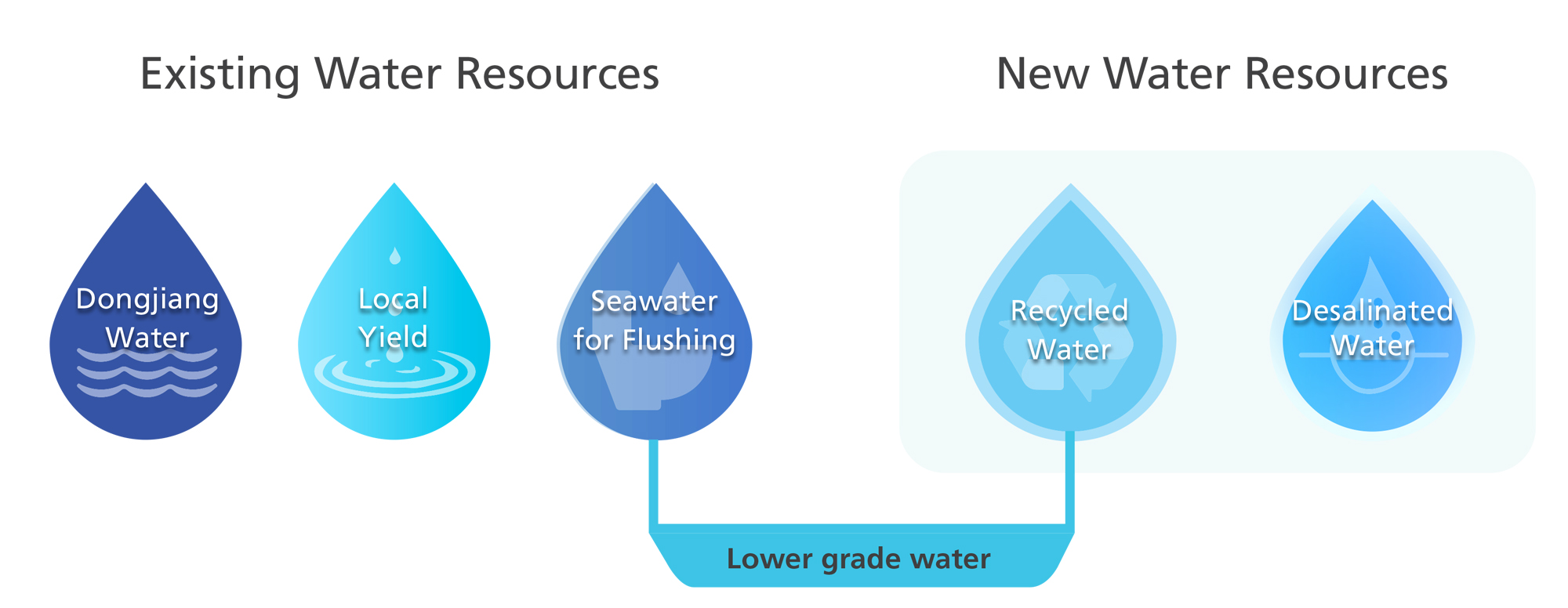
Based on the updated Strategy, Hong Kong's forthcoming water supply portfolio will comprise new water resources that remain unaffected by climate change, including desalinated and recycled water, alongside the existing supply of local yield, Dongjiang water and seawater for flushing. The new water supply portfolio will ensure the stability of Hong Kong's water supply and support the sustainable development of the city.
The long-term goal of Strategy 2019 is to increase the network coverage of using lower grade water for flushing from 85% to 90%. Lower grade water includes seawater and recycled water. The former has been widely used for toilet flushing since the late 1950s (please refer to the article "Use of Flushing Water" in this chapter). However, in some areas with a low population density, a longer distance from the coast and an unfavourable topography, transportation of seawater for flushing is more energy-consuming and less cost-effective. As a temporary measure, fresh water is therefore used for flushing.
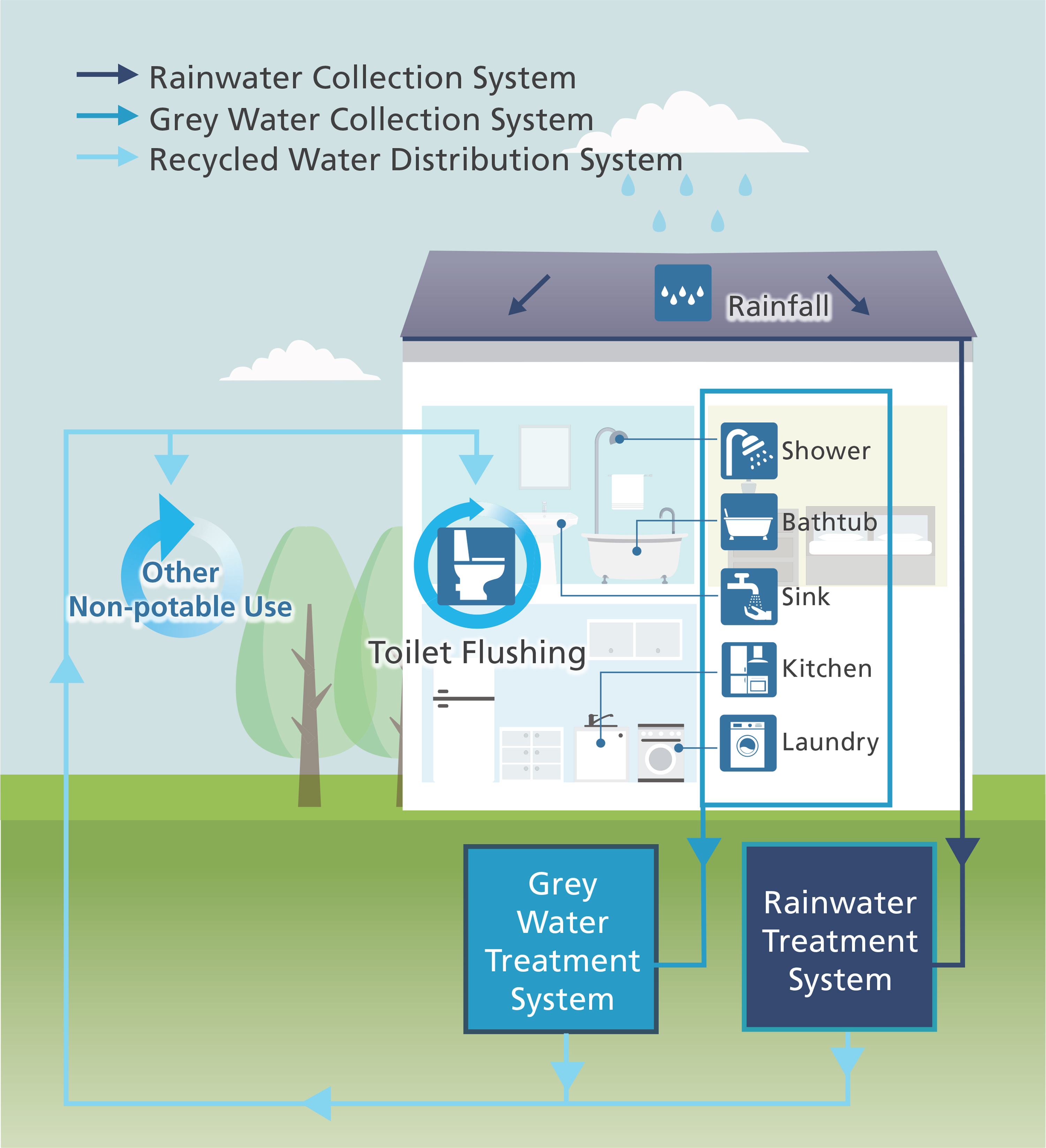
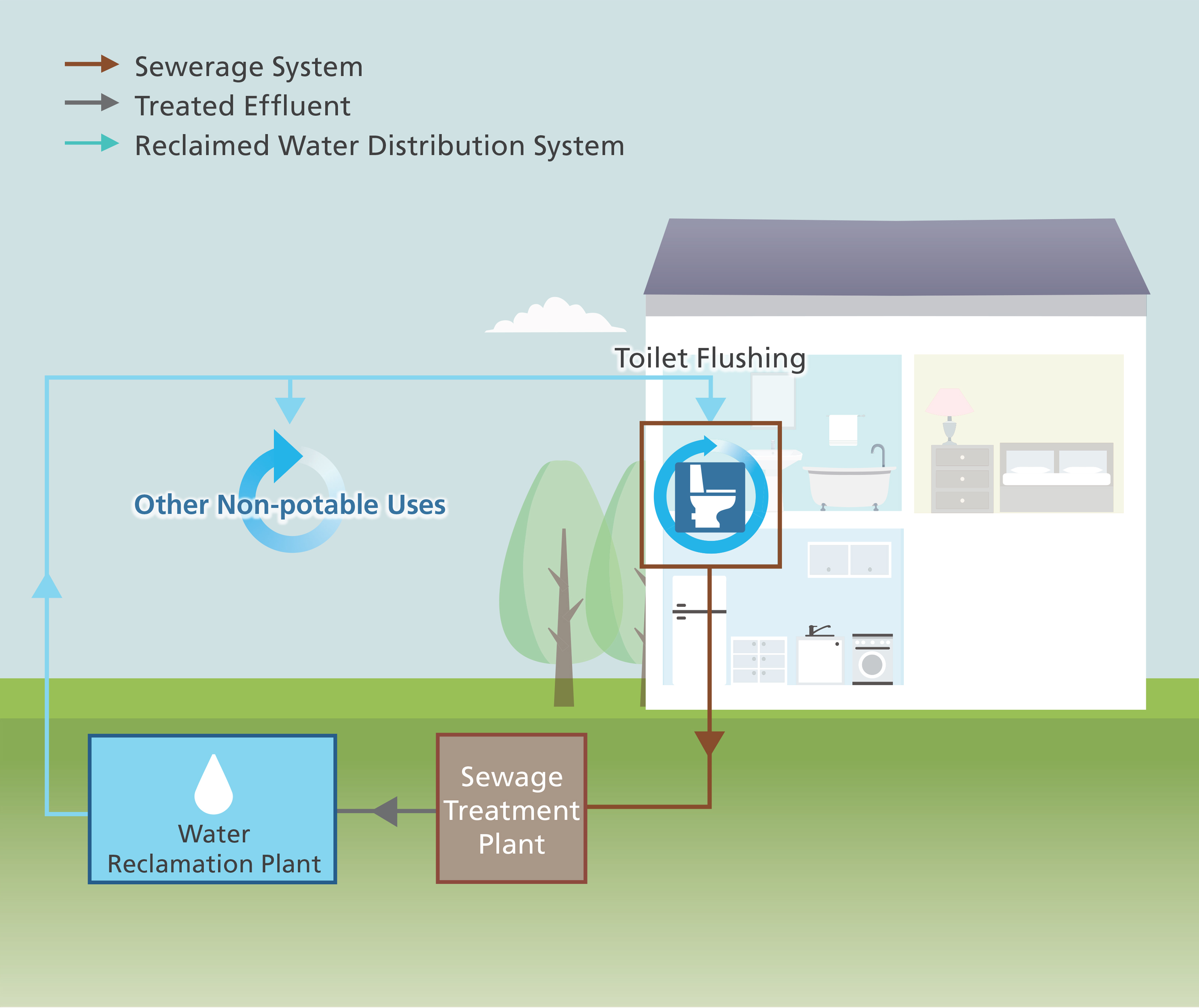
Recycled water includes reclaimed water, treated grey water and harvested rainwater. As recycled water does not meet the Hong Kong Drinking Water Standards, it is intended for non-potable uses only. The use of recycled water not only reduces the consumption of fresh water, but also minimises the impact on the environment by reducing the treated effluent discharged into the receiving water.