


Property owners are responsible for maintenance and management of the inside service of their building to ensure there is no contamination of the system affecting drinking water quality. Since December 2017, the WSD has randomly selected registered consumers and invited them to participate in the "Enhanced Water Quality Monitoring Programme". Each year, drinking water samples from approximately 670 premises are collected from customers’ taps for monitoring of the water quality.
Although participating in the programme is voluntary, the WSD encourages consumers to take part. The tests monitor six metals shown in the chart below. Since May 2021, two additional tests have been added, covering residual chlorine and Escherichia coli (E.coli).
If the test result of a drinking water sample is found to exceed the standard value, the WSD will provide advice and support to the concerned consumers, including:
The WSD collects drinking water samples from consumers for testing through this programme and compiles the test results into water quality statistics, published weekly on the WSD’s website.
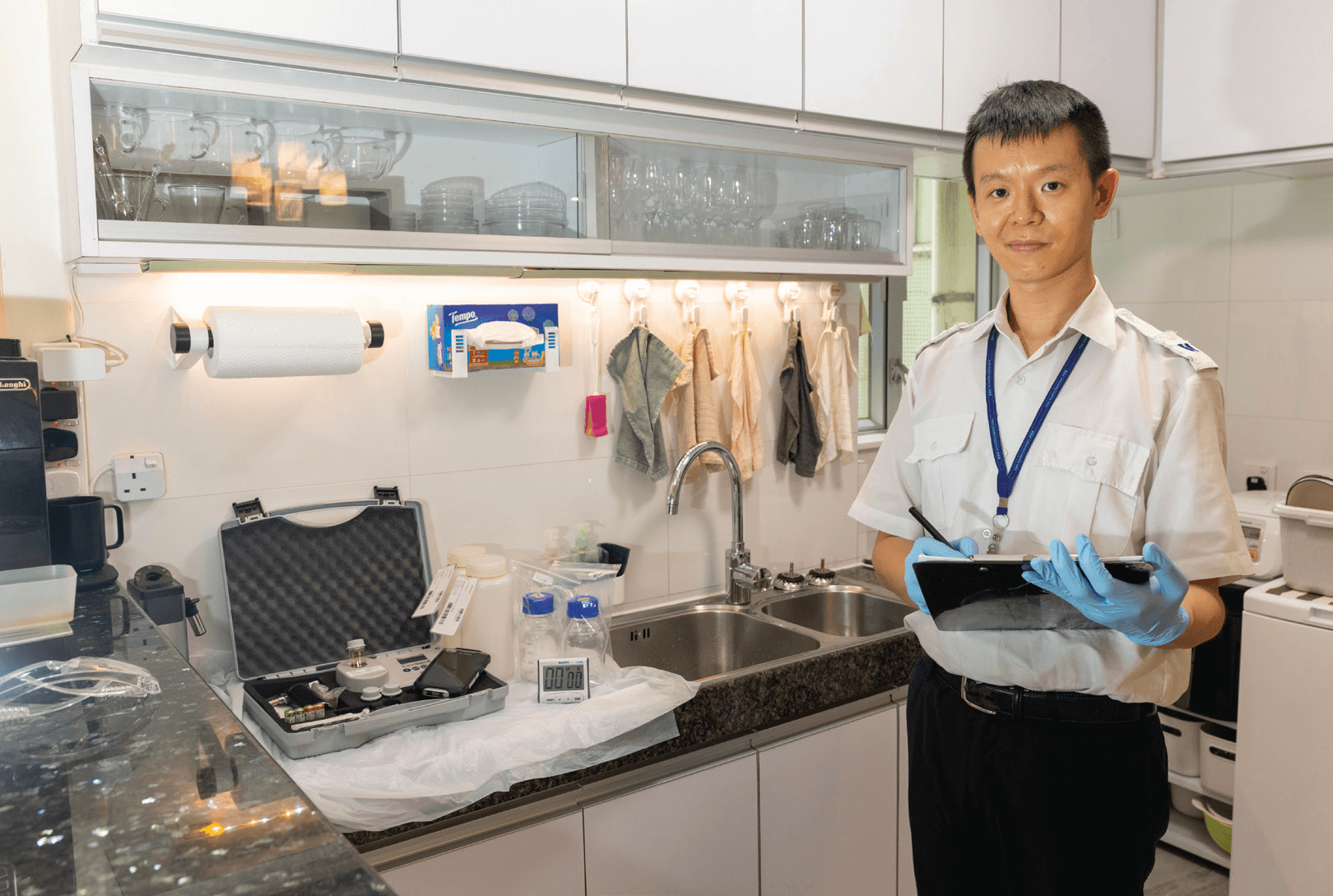
CHUNG Hon-ming has been working in the WSD for four years as a Water Sampler. He is one of the two WSD staff responsible for collecting daily water samples from consumers' premises. As a requirement of his work, he visits all areas of Hong Kong - including some remote locations. During the 30-minute period for collection of water stagnation sample, he often becomes a ‘spokesperson’ for the WSD. Many elderly residents he meets enjoy talking to him during his sampling visits.
As part of the Enhanced Water Quality Monitoring Programme, the WSD has appointed an independent consultant to assist in conducting a random selection of premises around Hong Kong. Two or three of the 18 districts are selected, with one building and a number of consumers selected from each of the districts. The WSD will notify and invite customers to participate two weeks prior to taking water samples. CHUNG explains that he would visit the premises with a licensed plumber when taking water samples. The sampling process typically involves three rounds, starting with a one-litre sample of unflushed water from a drinking water tap, followed by another one-litre water sample after a two-minute flow of flushing. The plumber would inspect the premises’ plumbing system and pipework, record the length of the plumbing and the diameter of the pipes. He would then estimate the required number of auxiliary water samples, typically ranging from three to seven one-litre water samples. Before the final round of sampling, the water samples are taken after flushing the tap for five minutes and then stagnating (kept still) for 30 minutes. CHUNG says that the waiting time is not short, and many consumers take this opportunity to enquire him about water supply services and water quality. In preparation, he tries to learn different kinds of waterworks knowledge. In some occasions, the waiting time become the period of the elder’s personal story sharing.
CHUNG says that during his work, he has had the chance to visit different areas in Hong Kong, including remote villages in the northern New Territories and many different types of residence. This experience has broadened his horizons and highlighted the extensive reach of the WSD's services throughout Hong Kong.