



The maintenance and repair of the city’s water supply systems requires both knowledge and extensive hands-on experience. Since 2000, there has been an increase in efficiency and meeting improvement targets within the maintenance division, as well as more direct customer contact. Frontline staff must be equipped with a wide range of skills requiring systematic training and learning new knowledge.
A majority of management staff in the maintenance division are now considered to be 'master craftsmen'. They graduated from the Apprentice Training Scheme, launched by the government in 1955 to recruit young people to address the shortage of engineering talent after the Second World War. At that time, the Waterworks Office1 under the Public Works Department, together with the Electrical and Mechanical Office (now the Electrical and Mechanical Services Department) and the Kowloon-Canton Railway Department jointly organised the first training courses and enrolled 16 apprentices to be educated in the required skills. Over the next 40 years, the demand for technical skills in the engineering profession increased and apprenticeship programmes were expanded to include a five-year craftsman apprenticeship programme, and a four-year technicians apprenticeship programme. In 1980s, an electronics apprenticeship programme was introduced.
Due to the professional and unique nature of water facilities maintenance, the WSD launched an apprentice training scheme in 2015. Approximately ten trainee technicians II are recruited each year to undergo on-the-job training. As of 2022, the WSD has organised eight apprentice training schemes and trained 59 trainees.
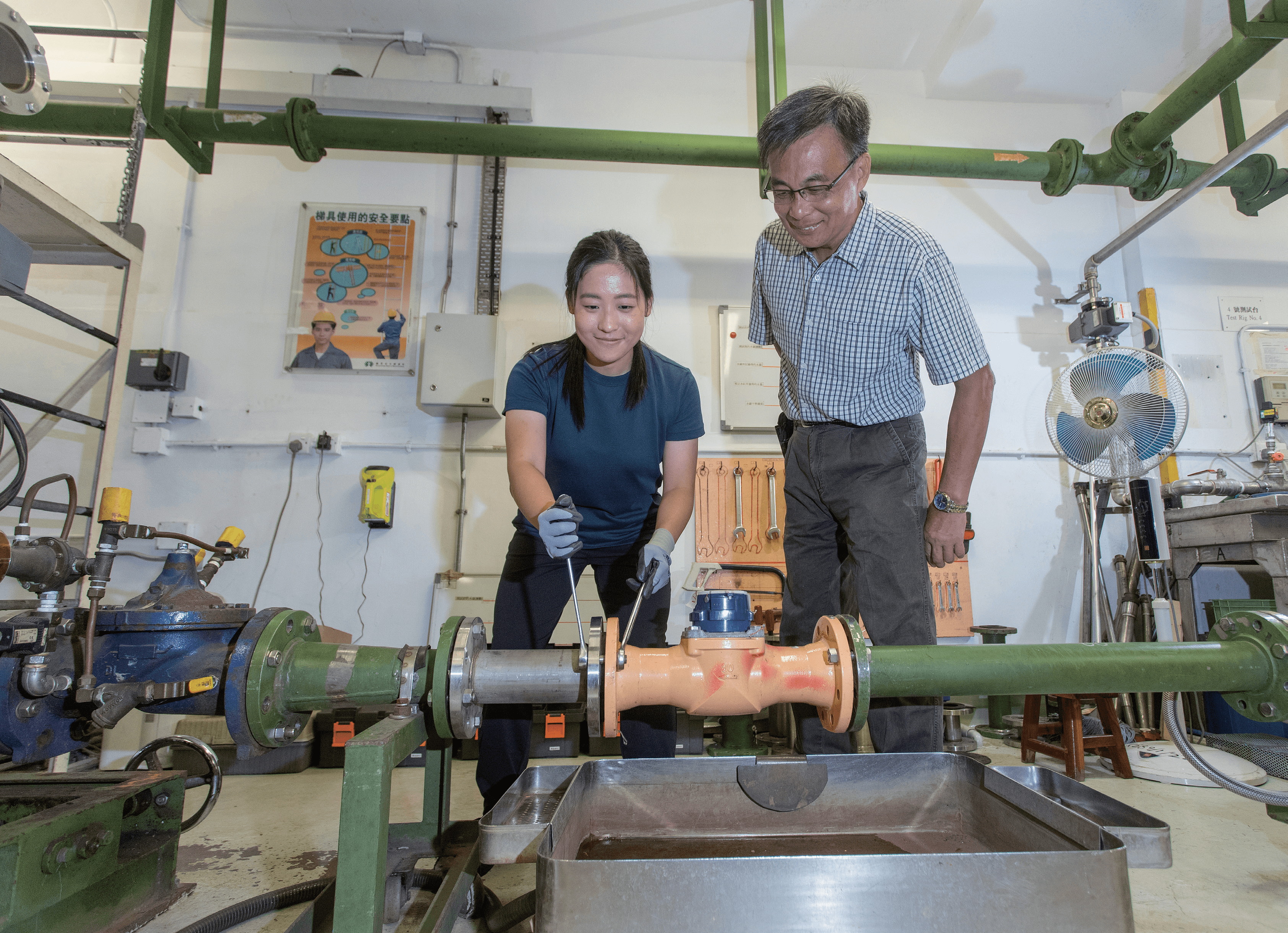
From Apprentice to Chief Waterworks Inspector of the Mechanical Workshop
KI Tak-sun, who now works at Lung Cheung Road Mechanical and Electrical Workshop and will soon retire, joined the apprenticeship programme in 1977 at the age of 15, as one of 60 fellow apprentices in that year. He has since had a career spanning almost 45 years with the WSD. His father was also an artisan in the Waterworks Office, continuing the family relationship with the waterworks.
During the first six months of the programme, KI said he received basic training at Morrison Hill Technical Institute, which included courses in Chinese, English and mathematics, as well as classes in craft theory. In the second half of the year, he attended the apprentice training centre2 in the Electrical and Mechanical Office (now the Electrical and Mechanical Services Department) on Caroline Hill Road to receive professional technician training. Trainees were also required to study at technical colleges after class to acquire practical skills. The entire programme provided comprehensive and intensive on-the-job training, "I remember receiving my first month’s salary in cash, which was $375. As the first day of work that month was the 5th, I received a prorated deduction of $30. That was my first ever wage," KI recalled.
After completing one year of basic training, apprentices were assigned to various government departments based on their preferences, such as the Waterworks Office and the then Hong Kong Fire Brigade. This decision not only determined their area of study for the next three years, but also their career path. As KI’s father worked as an artisan in a salt water pumping station of the Waterworks Office, he had developed a keen interest in waterworks. "I’d heard him talk about his day-to-day work from time to time, and even visited his workplace. The deafening sound of multiple engines running is a very vivid memory, sparking a keen interest in machinery.” It was a natural choice for him to pursue an apprenticeship at the Waterworks Office, which only had three machine apprenticeships available. After being interviewed he was accepted, "I was interviewed and hired by the chief waterworks inspector of the mechanical workshop and have since been promoted to the same position. It is amazing how life works,” said KI.
During his four years of training, he learnt the basics of mechanical maintenance, including for pumps, water treatment equipment, plumbing and engine installation. After passing examinations, he became a mechanical artisan at the Waterworks Office. He first worked in the mechanical maintenance team of the Sha Tin Water Treatment Works, which was considered a "training ground" for the department. During his time there, he gained experience in maintaining various waterworks facilities. He continued studying alongside his senior colleagues after work and gradually progressed from Artisan to Works Supervisor II. Over time, his scope of work expanded from mechanical maintenance to include the operation of water treatment works. In 1994, he was promoted to Assistant Watersworks Inspector.
In 1997, he was assigned to the newly completed Ma On Shan Water Treatment Works. The facility had just been equipped with the latest computerised automatic control system for water treatment and quality monitoring. The transition from a manual to a fully automatic operation was not a simple process. There could be no margin for error as any interruption at the water treatment works would adversely impact the daily water needs of the public. “In the beginning, my colleagues were concerned about their ability to handle the new operations, particularly during night shifts when staffing was limited. If the system were to fail, our staff would need to respond quickly and take direct control of the water treatment works. To prepare, we initially trained our staff to operate the system manually, ensuring that the whole team was familiar with each part of the operating system before gradually transitioning to full automation. The transition was seamless, and we all felt a great sense of accomplishment afterwards,” said KI.
Even in an era of advanced technology, traditional maintenance techniques remain essential. As the Chief Waterworks Inspector of the mechanical workshop, KI Tak-sun is responsible for training new staff and apprentices to continue the skills and legacy he learned from his mentors.
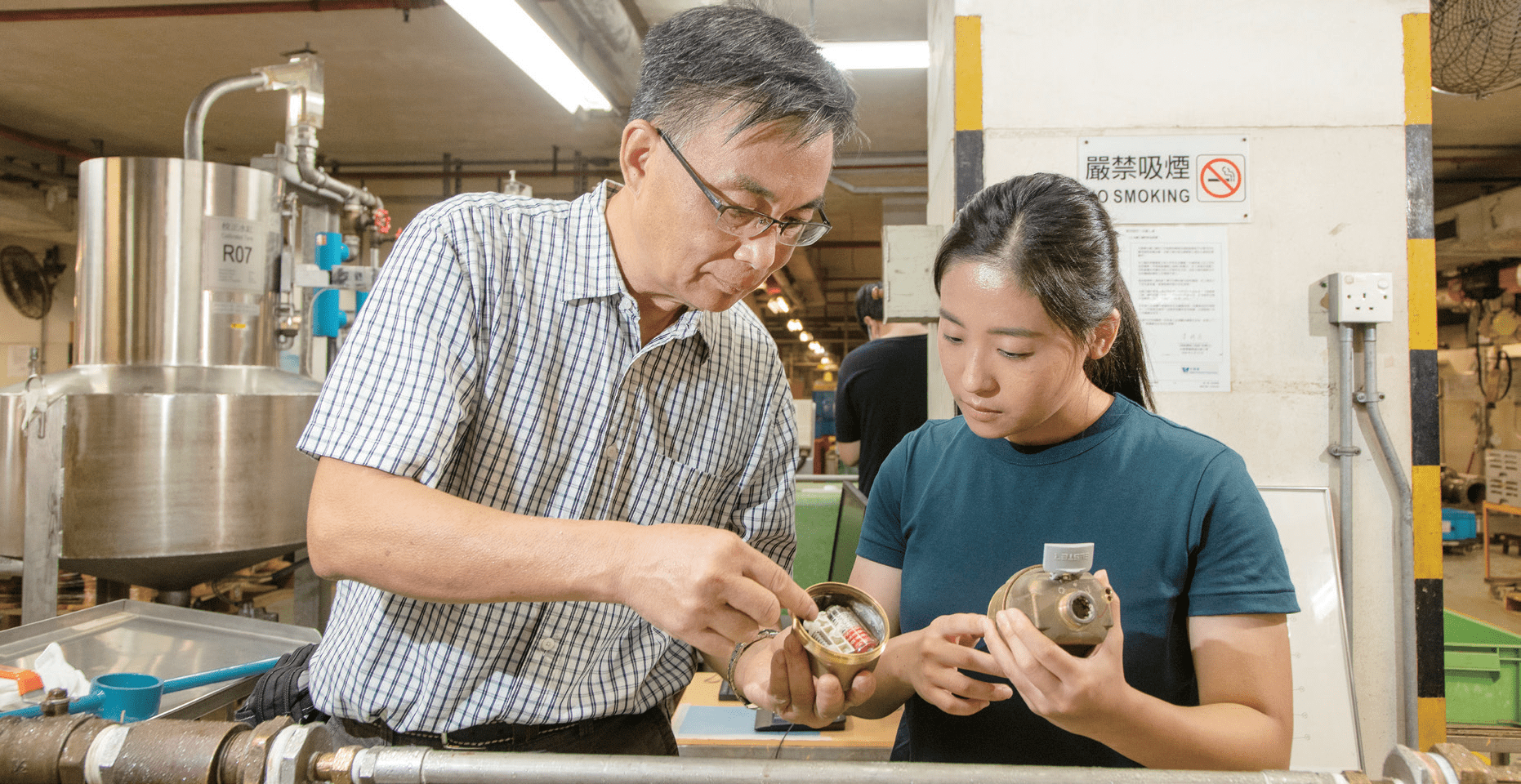
Female Apprentice to Consumer Services Inspector
Mechanical maintenance was traditionally male-dominated. KAO Fuk-yee, the first female apprentice under the WSD's apprentice training scheme, acknowledges that the physical work of mechanics can be more challenging for women. However, she is fortunate that many processes are now mechanically operated and she exercises every week to extend her physical fitness.
Although KAO studied business at secondary school, she was influenced by her friends and instead opted to study engineering. “I knew that my friends had enrolled in the first WSD's Apprentice Training Scheme and learned a skill that would provide them with a stable job in the future. I found myself wanting to do the same kind of work, because I'm not the type of person who likes desk work," said KAO. However, she was also not one of those mechanical geeks who grew-up disassembling clocks to study how they worked. So, to prepare, she first enrolled in the Construction Industry Council’s Basic Craft Course (Plumbing & Pipe-fitting). In the same year, she was accepted into the WSD's Apprentice Training Scheme, the only female in her class. During her two-year course, she gained experience in six different work divisions, including the Water Treatment Works, Water Loss Management Unit and Distribution Section. She gained a thorough understanding of the water distribution system including checking water quality, detecting leaks, and assisting with emergency water main bursts.
In 2018, KAO completed the Apprentice Training Scheme and was subsequently employed by the WSD as an Artisan. Currently, KAO works as a Consumer Services Inspector in the Customer Services Section. Her main responsibilities include replacing and conducting accuracy tests on old meters, as well as handling customer enquiries on water quality and supply. KAO recognises that water supply is a daily necessity, and any issues that arise can be a significant inconvenience to customers. Taught by her managers to be sensitive to a customers’ needs, her strong communication skills come in handy. The knowledge gained during her apprenticeship also comes into play. "Basic knowledge is crucial for customer service, particularly for public enquiries. We strive to answer questions and address their concerns professionally, earning their trust and respect,” says KAO.
- The Waterworks Office was initially a section under the Public Works Department, then upgraded as an independent department in 1982 and renamed as the Water Supplies Department (WSD).
- The apprenticeship training centre was demolished in 2019 and the site, together with the surrounding recreational land, was rezoned for commercial, government & institutional use.