



Water supply management would be more efficient and effective if there were a virtual water treatment and water supply network that could accurately simulate changes in water quality, flow, pressure and the operation of pumps, valves and other equipment. This would also assist in lowering energy consumption and encourage a more proactive operational management strategy.
Since 2000, there has been a significant emphasis on computerization and digitization on collecting and application of big data. Digital twin technology merges conventional and professional computing models of product or system design with real-time data received from sensor devices. As a result of data analysis, a product or system's operations can be depicted as a realistic image, giving rise to an identical twin of the real and virtual worlds. Some information technology research institutes in the United States have repeatedly recommended that the ability to develop a digital twin be recognised as one of the top ten current technological trends and a fundamental aspect of Industry 4.0 development.
Following the release of the "Hong Kong Smart City Blueprint" in 2017, the HKSAR Government published the "Hong Kong Smart City Blueprint 2.0" in 2020. The new blueprint presents 130 initiatives across 6 domains, including on "Smart Government". Various departments are now exploring the potential development for smart services. In 2020, the WSD implemented digital twin technology, which is being tested and studied in water treatment works and water distribution workflows. The article "Research and Development of Automated Water Treatment Monitoring" in Chapter 2 introduced the progressive integration of water treatment works from automation and remote control systems to a digital twin technology in recent years. This article describes the development of water supply and distribution networks in this respect.
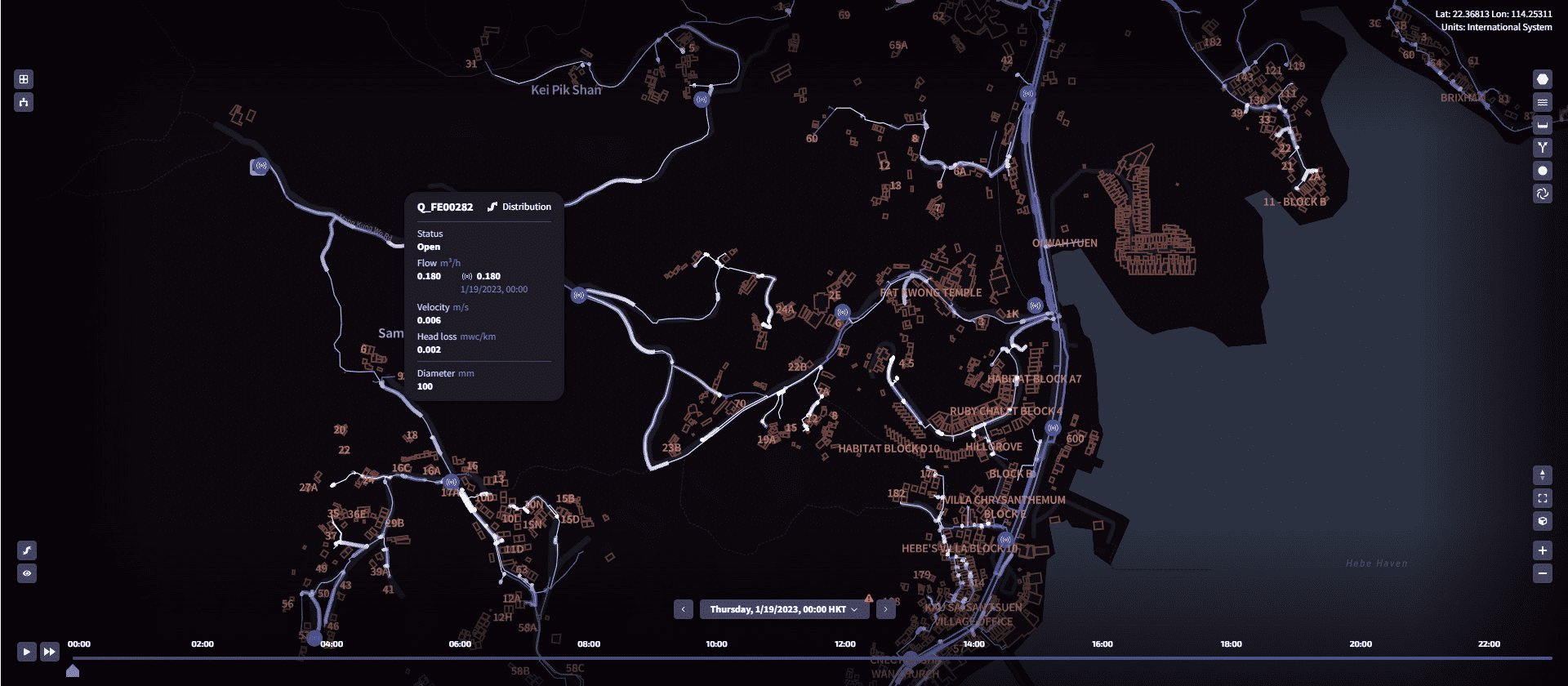
A Digital Twin for a Water Supply Network
The water supply network in Hong Kong serves a population of more than seven million people. It spans water treatment works to the service reservoirs in each district and then to water supply points in every street and building. This is arguably one of the most intricate systems in the world for a single water utility serving such a high density of customers. With the development of the Water Intelligent Network (WIN) (as detailed in the article "Smart Technology Management of Water Mains and Water Leakage" in this chapter), the territory's fresh water distribution network is being divided into approximately 2,400 District Metering Areas, each with fitted sensors to capture data on particular pipe sections, facilitating the monitoring and control of water leakage, and ultimately reducing overall water loss.
As the data collection network is gradually being established in the system, the implementation of digital twin technology will allow for greater utilisation of the data. In fact, the use of this technology in water facility management has proven effective in other parts of the world.
Digital twin is the outcome of merging various technologies that are well established in research and development, including machine learning and artificial intelligence. Hydraulic models are built in the digital twin system based on information on the configuration of the water supply network, the distribution of customers and their water consumption. Combining the hydraulic models together with data collected from WIN and other WSD systems, the digital twin system operates as a simulation of the water supply network. The system was first tested in a smaller area of New Territories East to gain experience in preparation for future digital twins for all of Hong Kong’s water supply networks.
Possible Future Applications
When implemented in a water distribution system, digital twin technology can enhance the accuracy of predictions, leading to more effective water pressure management and higher energy efficiency. By obtaining accurate data on water demand, water pressure can be adjusted to the appropriate level by reducing the operation of certain pumps. It is worth noting that pumps tend to be one of the most energy-consuming components of a water supply system. If greater efficiencies can be achieved, substantial energy savings will follow over the long term. In addition, it is often essential to adjust water direction or flow to minimise any disruption before undertaking maintenance on the water supply system. Implementation of digital twin technology to simulate outcomes enables waterworks staff to make better preparations.