



Waste is when we consume more than we need. What can we do to avoid waste in our daily lives?
The WSD engaged consultants to conduct Domestic Water Consumption Surveys in 2011 and 2015. The 2011 survey found that for the 1,028 households that take showers for bathing, the average frequency of having a shower was 1.04 times per day per person, the average shower time was 6.7 minutes, and the average water consumed was 55.2 litres each time. Showers for bathing account for the highest water consumption for individuals, while the most water-consuming domestic activity was using a washing machine. For each household, the average per capita daily water consumption for laundry by a washing machine is 13 litres. Conducted four years apart, the two surveys found that the smaller the household size, the higher their per capita daily water consumption. In addition, the average per capita daily domestic fresh water consumption of the surveyed households increased slightly from 124.7 to 126.9 litres per person. This is a small but significant increase for a community of about 7 million people.
Since the introduction of the “Total Water Management Strategy” in 2008, Hong Kong has implemented a number of measures to exploit new water supply resources and reduce consumption. One such measure is the launching of the Water Efficiency Labelling Scheme (WELS). The scheme addresses the water efficiency of plumbing fixtures and water-consuming devices by establishing standards for water efficiency through grading. Consumers can select products with reference to its grade. By raising awareness of these products, the community is encouraged to reduce water consumption.
The scheme currently covers six types of plumbing fixtures and water-consuming devices, including showers for bathing1, water taps2, washing machines3, flow controllers4, urinal equipment5 and water closets6. Their water efficiency is rated under a grading system according to their flow rates, water consumption or flush volumes (as appropriate). The WELS labels show four grades, ranging from Grades 1 to 4. Grade 1 is marked by one water droplet; Grade 2 by two water droplets, and so on. Fewer water droplets indicate less water is consumed by using that product, hence the higher its water efficiency.
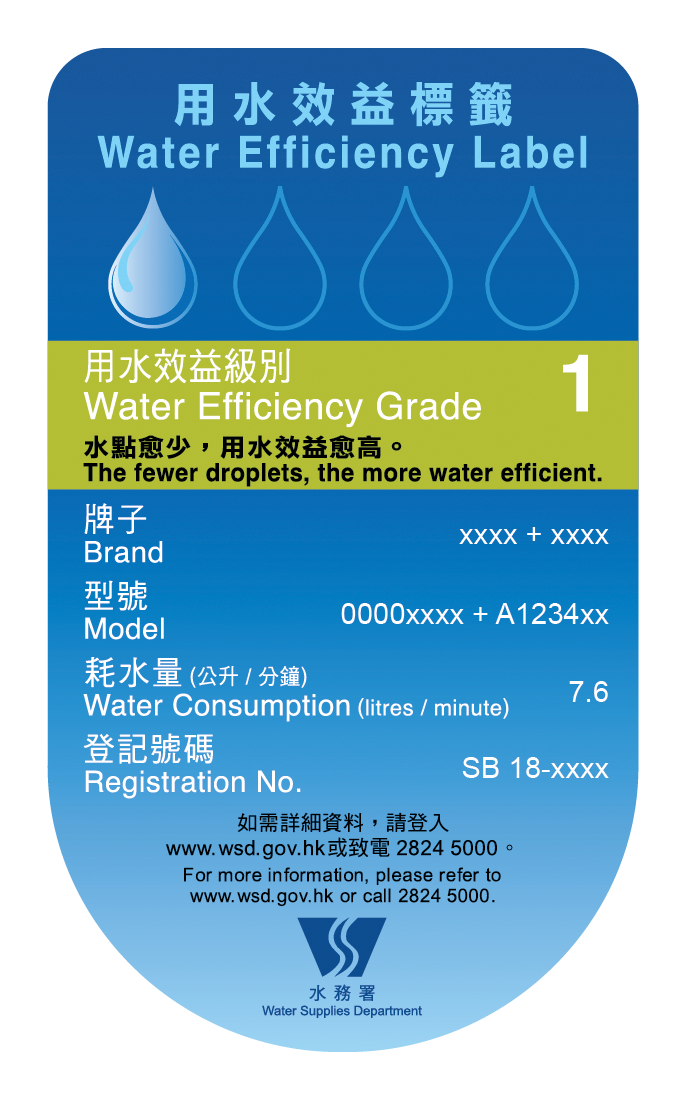
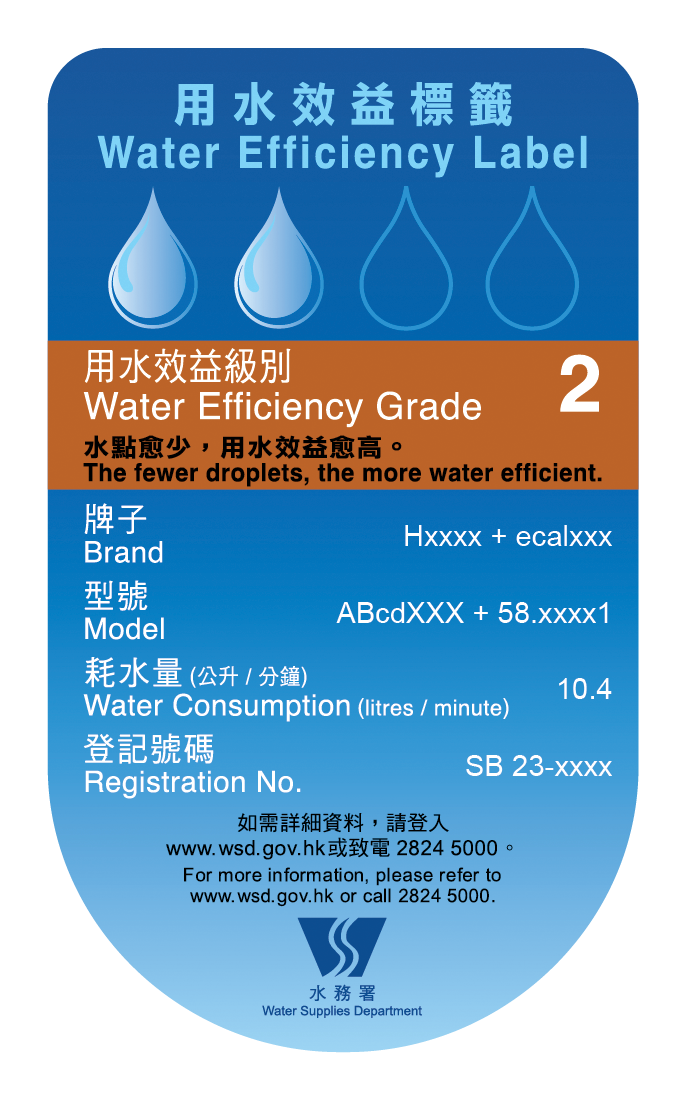
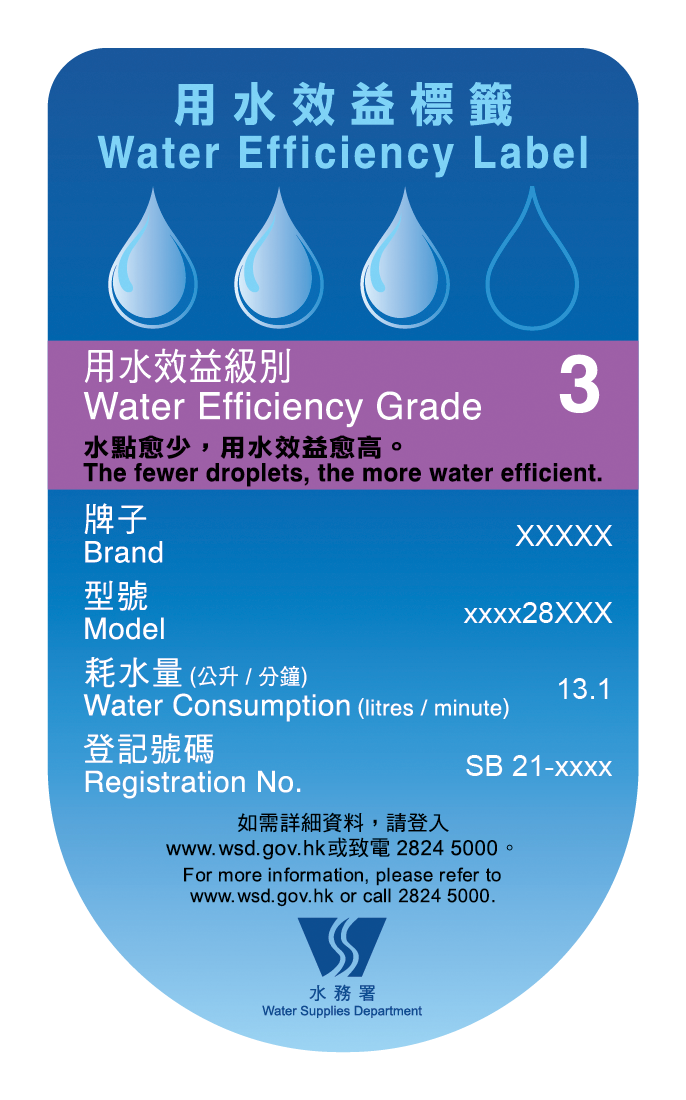
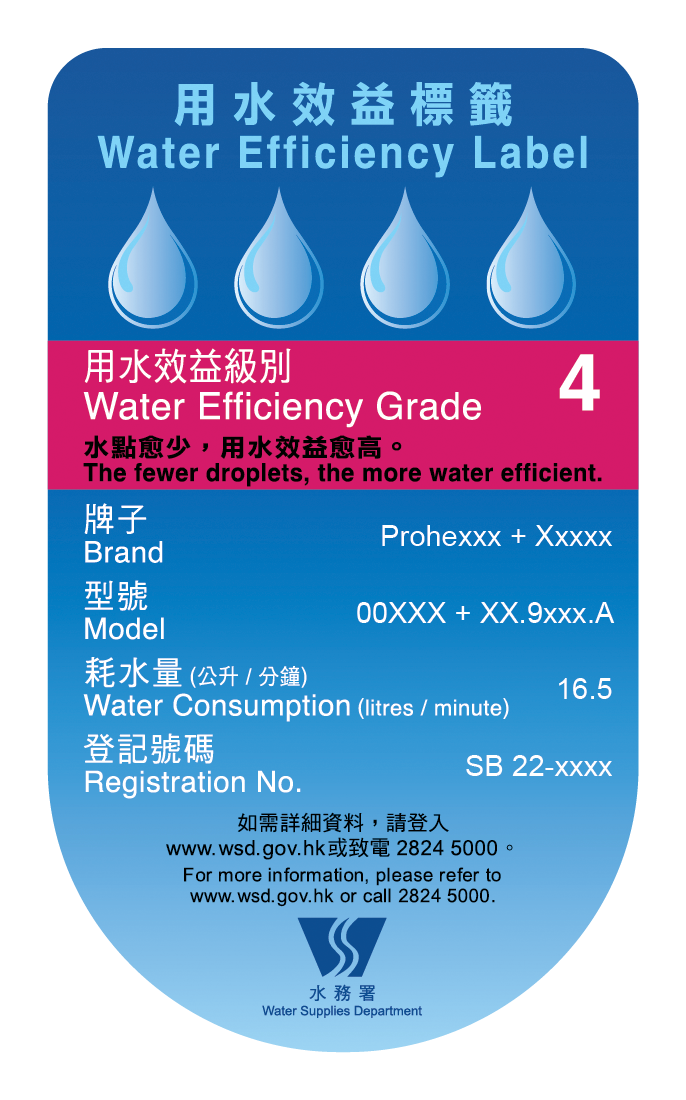
As an example, showers for bathing are tested in accordance with a set of criteria outlined in the scheme document. The water efficiency of a shower is then rated to different grades according to its nominal flow rate. Grading is tested in a shower test rig by measuring water as it passes through the shower at dynamic flow pressures. When a flow rate stabilises, these pressures are recorded at the ambient water temperature. The resulting average flow rate is the nominal flow rate. If the nominal flow rate of the shower for bathing is equal to or less than nine litres per minute, a Grade 1 rating is given. The nominal flow rates for other grades is given in the table below.
Showers for Bathing
| Water Efficiency Grade | Nominal Flow Rate (f = litres/minute) | Droplet Symbols Shown on the Water Efficiency Label |
|---|---|---|
| Grade 1 | f ≤ 9.0 | 1 water droplet  |
| Grade 2 | 9.0 < f ≤ 12.0 | 2 water droplets  |
| Grade 3 | 12.0 < f ≤ 16.0 | 3 water droplets |
| Grade 4 | f > 16.0 | 4 water droplets |
Non-mixing-type Water Taps
| Water Efficiency Grade | Nominal flow rate (f = litre/ minute) |
|---|---|
| Grade 1 | f ≤ 2.0 |
| Grade 2 | 2.0 < f ≤ 4.0 |
| Grade 3 | 4.0 < f ≤ 6.0 |
| Grade 4 | f > 6.0 |
Horizontal Drum-type Washing Machines
| Water Efficiency Grade | Water consumption (W) = litre/ kg/ cycle |
|---|---|
| Grade 1 | w ≤ 9.0 |
| Grade 2 | 9.0 < w ≤ 11.0 |
| Grade 3 | 11.0 < w ≤ 13.0 |
| Grade 4 | w > 13.0 |
Different plumbing fixtures and water-consuming devices are graded based on their nominal flow rates, water consumption or flush volumes (as appropriate). Details are available on the WSD website:
Water efficiency labelling schemes have been implemented in many countries, in various ways, and at different stages of development. Some countries have made it mandatory for certain plumbing fixtures and appliances to carry a water efficiency label before being sold in the market. Others have introduced water efficiency labelling schemes on a voluntary basis. In Hong Kong, WELS has been implemented progressively since 2009 on a voluntary basis. Manufacturers are encouraged to apply for registration under WELS and conduct tests according to the scheme. This helps consumers make informed choices while allowing time for the market to switch to higher water efficient products. Currently, the WSD is working to amend the legislation requiring the supply of prescribed WELS types of products in Hong Kong to be registered and labelled under the Scheme to support long-term water resource management.
- Covering shower heads installed to fixed arms/concealed pipes in a wall or ceiling, shower heads installed to pivot arms and hand-held showers.
- Covering water taps of hot and cold water mixing (mixing) or non-mixing types installed in bathrooms/toilets, washing basins and pantry/kitchen sinks. Those water taps equipped with automatic sensing open/close devices or automatic closing mechanism are also included. However the water taps installed in bath tub/shower, any system, machinery and devices such as irrigation systems, washing machines, water dispensers, etc. which serve for bathing/operational uses, are excluded.
- Covering washing machines that have a washing capacity not normally exceeding 10kg for household use. Washing machines that have a larger capacity or for industrial use or have no spin extraction capability or use non-electric energy sources are excluded.
- Covering flow controllers used with water taps or showers for bathing.
- Covering urinals with traps and automatic/manual urinal flushing valves. Urinals with traps coupled with urinal flushing valves to form a combination or urinal suite (urinals with traps equipped with integrated sensing-type flushing valves) are also included.
- Covering toilet suites (one-piece water closet pan), water closet pan only, water closet cistern only, and a combination of a water closet pan and cistern (close-coupled suite).