



Each person on average drinks about two litres of fresh water per day. The legal specifications in Hong Kong for toilet flushing is 7.5 to 15 litres of water per flush. So, with an average of six or seven toilet visits per day, flushing requires up to 105 litres of water per person. Currently, about 85% of Hong Kong’s population was covered by seawater supply network. In 2021/22, the average daily amount of seawater used for flushing was 876,000 cubic metres (m³), equivalent to 30% of the average daily consumption of potable water.
If the WSD had not taken the bold decision to introduce seawater flushing 50 years ago, Hong Kong may have faced even greater pressure on its water supply. At the time, this decision saw Hong Kong as one of the few places in the world to pioneer seawater flushing technology.
Sanitation issues can be resulted if there are insufficient water resources. In the mid-19th century, as the city of Victoria slowly grew, the issue of toilets and sanitation illustrated the cultural and lifestyle differences between officials and the general public, and between China and the west.
In the 19th century, a number of doctors reported on Hong Kong’s sanitation conditions. Criticism was made over such issues as: sewage discharge and its treatment, and the use of earth privies. Sir John Pope HENNESSY, Hong Kong’s Governor held a different viewpoint from these doctors on whether the water closet or the earth privy was more suitable for the city’s Chinese community. He quoted Dr. John DUDGEON, a consultant physician in Peking, who believed that the Chinese made good use of human waste as fertiliser for farming by using the earth privy. Although smelly, it did not cause disease, whereas the European water closet was a hotbed of disease1.
The practice of collecting manure (night soil) for farming had gradually changed as Hong Kong had increasingly moved towards commercial trade. In those days, outbreaks of disease and epidemics amongst British soldiers and European merchants pressured the government to improve the environment, amenities and update the building regulations.
In 1882, Sir Osbert CHADWICK, a consulting engineer appointed by the Colonial Secretary, published Mr. Chadwick’s reports on the sanitary condition of Hong Kong (commonly known as “Mr. Chadwick’s Report”). It investigated the connection between infrastructure, building and sanitation in Hong Kong. In the early years, water closets were only found in European houses, whereas the Chinese community relied on wooden buckets for disposing human waste. These buckets were manually transported and emptied. Most public toilets in the community were privately owned and intended to collect human waste for sale as fertiliser2. Given the profitability of this trade, there was little incentive for the government to spend public funds on its management.
CHADWICK also reviewed disease data, waste collection frequency and methods amongst different social classes and between districts, the bacteria incubation period in human waste, and differences in bacteria retention between materials used in private and public toilets. The report highlighted in detail the underlying issues and provided justification for the development of water closets and improvement of the sewage system, particularly in densely populated places such as military barracks and hospitals.
The year after Mr Chadwick’s Report was published, the government set-up the Sanitary Board (the predecessor of the Urban Council3) to supervise the city’s sanitation. However, constrained by older building specifications, the installation of water closets in restaurants and teahouses was not regulated until the early 1940s, and at the beginning was resisted by the restaurant industry. There was also a chronic shortage of fresh water supply and most flushing toilets in the early days were connected to untreated fresh water sources such as wells, streams and rainwater.
In 1954, the government amended the law to prohibit the use of tap water for toilet flushing with offenders liable to a fine of HK$500. At the time, there were shortages of tap water, well water and stream water. The Urban Council was concerned that the lack of water for flushing made the water closet system inferior to the previous arrangements, and that environmental pollution would increase.
Following the Shek Kip Mei fire, the construction of large-scale public housing was initiated by the government in the mid-1950s. This provided an opportunity to also introduce the water closet and district sewerage systems. In 1957, seawater flushing systems were piloted in the Shek Kip Mei Resettlement Estate and Lei Cheng Uk Resettlement Estate. The earliest resettlement blocks had communal trench latrines, which were later replaced with individual flush toilets in each flat.
In 1959, the government enacted Cap. 123I Buildings (Standards of Sanitary Fitments, Plumbing, Drainage Works and Latrines) Regulations. Section 19 of the Regulations requires new private buildings to be equipped with flushing sewage facilities, including flushing systems, sewerage, flush toilets and other fittings. Since then, water closets have been essential for the public, and the seawater flushing network has expanded over time. In 1965, further legislation was introduced for new or redeveloped buildings to be equipped with pipes suitable for seawater flushing systems. Consequently, separated supply system for fresh water and flushing water was established in Hong Kong.
Hong Kong is surrounded by sea on three sides, making it suitable to develop a comprehensive seawater flushing supply system. This has led to the establishment of a seawater flushing supply system independent of the city’s fresh water supply system. As seawater is at a low height level, the requirements for water quality and treatment methods for flushing water are different, making the distribution methods for seawater different from that of fresh water. For details, please refer to the article “The Principles Behind Hong Kong’s Unique Drinking Water Distribution Systems” in Chapter 3.
At present, there are 35 pumping stations and 55 service reservoirs in the seawater flushing system in Hong Kong, with a total storage capacity of nearly 260,000 m³, and about 1,600 kilometres4 of seawater pipes. The pipes employed are primarily composed of cement-lined ductile iron pipes, cement or epoxy-lined mild steel pipes, and plastic (polyethylene) pipes.
Hong Kong is now the only city in the world with such an extensive seawater supply network used for flushing. Its seawater supply network covers about 85% of the population at the end of 2022. In 2021/22, the consumption of seawater for flushing is 320 million cubic metres, which is 31% of fresh water consumption. The average cost of flushing seawater treated by the WSD is HK$4 per cubic metre, compared to HK$10 per cubic metre for fresh water, about 2.5 times costlier. The seawater flushing system, which has been expanding over the past half century, has achieved remarkable results in conserving and exploiting water resources. The separate diversion of flushing seawater and fresh water has also proved to be successful. In 2001, the WSD’s seawater flushing projects were awarded the Chris Binnie Award by the Chartered Institution of Water and Environmental Management, recognising its achievements in sustainable water management with Hong Kong’s seawater flushing serving as a model for the rest of the world.
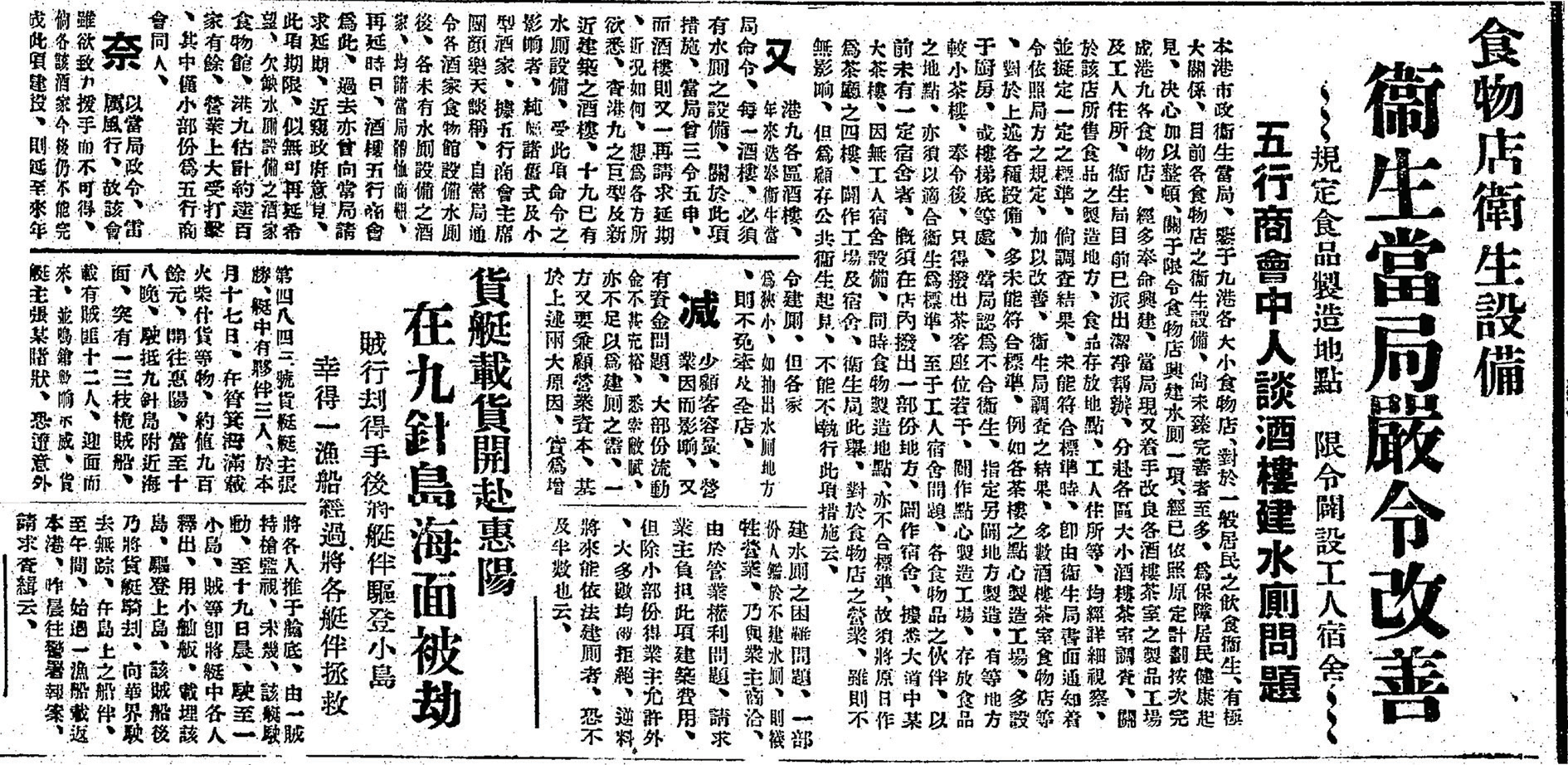
Source: Hong Kong Business Daily, 21 July 1941
In early 2021, the Tung Chung East Reclamation area had commenced to extend the coverage of seawater flushing with a salt water pumping station, a salt water service reservoir and associated pipelines. For the scattered populations in the central and northern inland areas of Hong Kong, far from the coast, fresh water flushing remains a more technically feasible and cost-effective option. The WSD is also exploring the use of "recycled water" (i.e. reclaimed water, treated grey water and harvested rainwater) from a centralised water supply system for flushing and other non-potable uses. For more details, please refer to the article “New Water Resources” in this chapter.
- Governor's Report on Blue Book (1880). Administrative Reports for the Year 1880. (12). https://digitalrepository.lib.hku.hk/catalog/bz60jz89v#?c=&m=&s=&cv=11&xywh=106%2C1714%2C1759%2C748
- O. Chadwick (1882). Mr. Chadwick's reports on the sanitary condition of Hong Kong; with appendices and plans.
London: Printed by George E.B. Eyre and William Spottiswoode, for Her Majesty's Stationery Office. 18-20. https://wellcomecollection.org/works/mpnmmdbz - The Urban Council was Hong Kong’s municipal authority from 1883 to 1999, and was initially responsible for food and health, and after 1985, also for culture and recreation on Hong Kong Island and in Kowloon.
- Calculation to 31 March 2023