Demand Forecasts
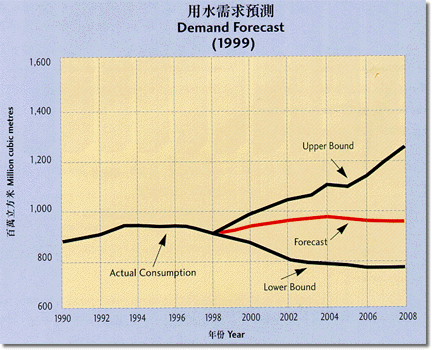
Long-term demand forecasts for water supply are thoroughly reviewed each year by the Administration and Planning Branch, which is headed by an Assistant Director, to cope with changes in Hong Kong's economic and demographic trends.
This practice in demand management has been in effect since 1991, and has enabled the Branch to deal more efficiently with the shifting need for water supply from the industrial sector to the domestic and service sectors, and in particular for the development of the new airport and related projects in North Lantau.
Careful assessment of the scope, cost considerations and achievable target dates at planning stages of capital works projects has also enabled a reliable watch to be kept on the completion of all projects on time and within budget.
Meanwhile, with the reliable and adequate supply of water from Guangdong, more emphasis is being placed on both the construction of treatment works to supply new towns and the replacement of the underground mains.
Reviews of the water storage position for the three years from 1999 have been completed, and systems studies carried out show the need for an extension of the water supply to meet other new developments as well.
Work is continuing on the provision of four Mainland Regional Depots, and two of them - those of the Mainland South East and South West regions - are expected to be completed in 2000.
Staff Training
Staff are sent regularly on study visits and to attend conferences to keep up with developments in the water supply industry. During the year, some 35 officers were sent to the Mainland, and other countries in Asia as well as to Switzerland, the US, UK and Australia.
Some $3.7 million was spent on staff training - about the same as the year before.
In addition, two consultant firms were commissioned to conduct courses on project management for professional staff and on customer service.
Information Systems Strategy Study (ISSS)
The importance of information technology for overall efficiency and effectiveness, as well as for long-term business planning, has for long been recognised by the Department.
With the support of the Government a nine-month study on strategic planning of information systems and technology for use by the Department was completed in March 1999. As a result, a feasibility study on the implementation of the first stage of the 'Information Systems Strategy Plan' is scheduled to start in September 1999 for completion in March 2000, prior to implementation.
Geographical Information System (GIS)
The development of a compatible geographical information system will be included in the implementation of Stage Two of the Information Systems Strategy Plan which forms the foundation for improvement in operational efficiency.
Local Area Network
During the year, work was completed on the installation of all local area networks (LANs) and their inter-connection between all regional offices, laboratories and the Headquarters for better communication.
Divisions and Units
- The Planning Division's major functions include planning water supply systems and computer systems.
- The Training Unit is responsible for the training and development needs of staff, and has devoted a lot of attention to promoting the wider use of the Chinese language, and raising the managerial competence of staff.
- The Computer Services Unit's key function is to enhance computer applications for greater efficiency in dealing with data and information, as well as with management and operations. One of the major duties of the Unit during the year was to deal with the Y2K problem and co-ordinate the rectification work.
- The Professional Statistical Services Unit is responsible for providing statistical advice and supporting services, conducting opinion surveys on customers and staff, undertaking statistical analyses and research on specific areas and reviewing the compilation of statistics with the Department.
- Among its activities, the Technical Administration Unit provides support on technical matters, helps prepare annual estimates, conducts reviews on organisation and structure of engineering divisions, and formulates department welfare strategy.